
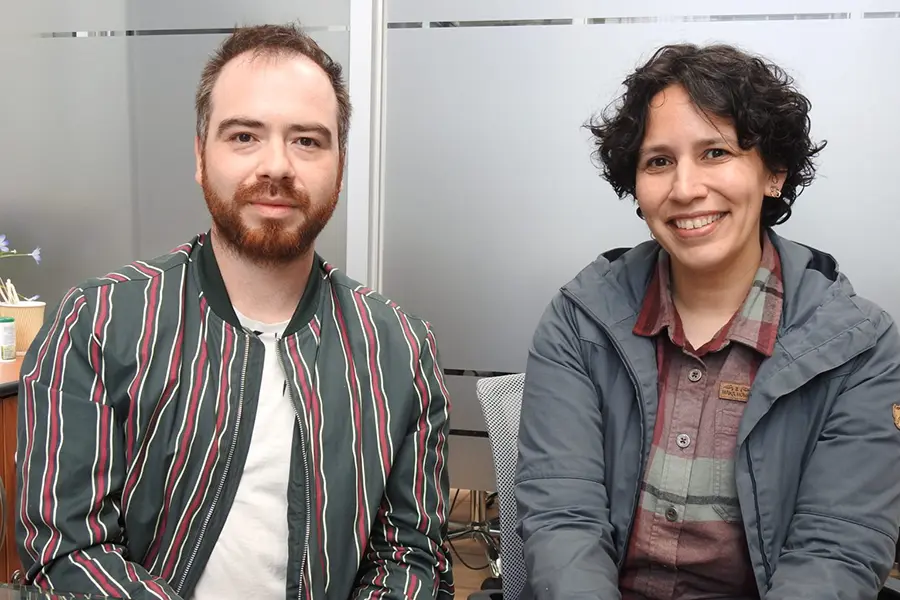
As part of the Anillo ATE250052 Project, Carolina Merino and Ignacio Jofré, researchers from the Scientific and Technological Bioresource Nucleus (Bioren, its Spanish acronym) at Universidad de La Frontera (UFRO), began the first of three expeditions planned within this study, which is integrated into the 62nd Antarctic Scientific Expedition (ECA 62), coordinated by the Chilean Antarctic Institute (INACH, its Spanish acronym).
This scientific campaign, lasting a total of one month, will make it possible to analyse human impact on Antarctic territory through indicators such as contaminants, heavy metals, microplastics and resistance genes, which will be detected in samples of glacial ice, meltwater, soil, rocks, rhizosphere, plants, marine sediments, fish and invertebrates.
The scientific team is currently working on islands in Antarctic territory, particularly those located within the pre-Antarctic and Antarctic polar circle, where some of the most remote seasonal Chilean bases are located, including Base Teniente Luis Carvajal Villarroel, enabling sampling in areas such as Avian Island, Adelaide Island and Lagotellerie Island.
“In this first expedition of the project, we aim to establish an overall picture of the presence of contaminants across all sampling sites, identifying which areas present greater pressure and immobilisation, while also establishing indicators that allow us to detect the presence and/or absence of these contaminants. In this regard, our objective is to cross-reference information from the different research lines (e.g. plant physiology, animal physiology, microbiology, soils, mineralogy and social impact), helping us establish better contamination indicators and understand how the territory may be affected by these contaminants under different global scenarios”, explained Dr. Ignacio Jofré, researcher at Bioren UFRO.
Four researchers took part in this expedition: Dr. Carolina Merino, from the Department of Chemical Sciences and Natural Resources at UFRO; analyst Carmen Gloria Mariqueo, UFRO biotechnologist; Dr. Ignacio Jofré, from Bioren UFRO; and Dr. Felipe Zúñiga, from Universidad Austral de Chile. Scientists from different institutions are also working on the same platform to conduct their own research.
“We have three further expeditions planned over the duration of the project, and consecutive sampling campaigns will be carried out. In this first expedition, we are collecting samples for compositional analysis, which will then be distributed to the different research lines that form part of this project”, said Dr. Carolina Merino.
“For this purpose, we spent two weeks on board the Betanzos Vessel, operated by Grupo DAP and managed by the Chilean Antarctic Institute, and we will then remain for more than two weeks at Professor Julio Escudero Scientific Base to carry out sampling on King George Island. We would also like to highlight the importance of the INACH logistics team, which manages and organises field deployments. Likewise, the team led by Dr. Luis Vargas, Dr. Kurt Paschke and Dr. Daniela Nualart, specialists in aquatic organism physiology and researchers in the Anillo project, is already at Escudero Base conducting trials”, highlighted Dr. Jofré.
Natalia Bastidas Fuentes
BIOREN-UFRO