
Villarrica Volcano, one of the most active volcanoes in Chile and Latin America, stands out not only for its natural appeal but also for its high scientific interest. In this context, researchers from University of Portsmouth carried out a research stay on its slopes in collaboration with Universidad de La Frontera.
The researchers are Dr. Carmen Solana and Dr. Ehsan Khalif, who are carrying out an international exchange project funded by the Royal Society in the United Kingdom, focused on assessing geological risks associated with land-use change on volcanic slopes, using Villarrica Volcano as a case study.
The project is being developed in collaboration with Universidad de La Frontera through Dr. Ivo Fustos-Toribio, academic at the Faculty of Engineering and Sciences, with whom they share an interest in studying the relationship between volcanic soils, land-use changes and slope instability processes. To achieve this, approaches from geomechanics, soil mechanics and remote sensing analysis are being combined.
Dr. Carmen Solana explained that this international scientific collaboration began to take shape after identifying Chilean territory as a favourable setting for this type of research. “When we started thinking about studying volcanic slope stability under different land-use changes, Dr. Ivo Fustos immediately emerged as one of the people with the greatest expertise in this field in Chile. We got in touch, and from the outset he was very receptive”, she said.
She added that the project will enable this scientific cooperation to develop over one year. While the University of Portsmouth will focus on remote sensing analysis and potential terrain change patterns, UFRO will lead studies related to geomechanics and soil mechanics.
For his part, Dr. Fustos explained that “the question we are currently addressing is how volcanic soils may be affected in terms of stability considering different types of land cover, for example forestry plantations, native forest, and how this can be quantified. The way we have approached this at UFRO has been through laboratory testing developed under Fondecyt and Fondef projects”.
Fieldwork
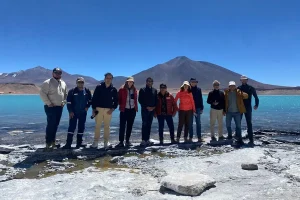
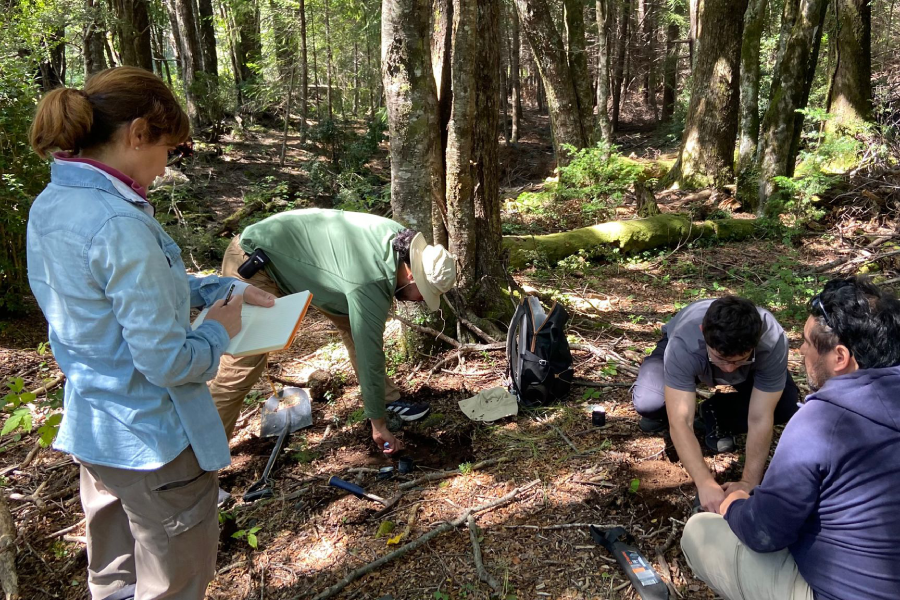
During their stay in the lake district, the researchers carried out intensive fieldwork, including soil sampling. A total of 18 samples were collected, tripling the initial target of six for this stage of the project.
The area surrounding Villarrica Volcano is characterised by the diversity of land use on its slopes, as well as its location in a zone of high tourist activity and associated natural risks. “This sector of the Araucanía Region has experienced very strong population growth since the pandemic. This means that places where mass movements or other natural processes were probably less relevant in the past may now generate greater impacts”, indicated Dr. Fustos.
For this reason, understanding how phenomena such as landslides occur in volcanic environments may provide key information for improving territorial planning and risk management processes in areas with these characteristics.
In this way, the researchers stated that they expect the results obtained from Villarrica to be applicable to other volcanoes in Chile, contributing to improved management in volcanic zones.
Exchange and Collaboration
As part of the exchange included in the project, Dr. Ivo Fustos-Toribio is scheduled to visit the University of Portsmouth next June, funded by the Royal Society, where he will work in satellite image analysis laboratories, rock mechanics laboratories, and on integrating the field data obtained.
In addition, the possibility of broader scientific collaboration will be explored. “For UFRO, this type of connection is important. We have academics who have been working significantly in the geosciences area over the past 10 years. These opportunities strengthen what we do and allow us to make visible the major questions we face in the southern hemisphere”, added Dr. Fustos.
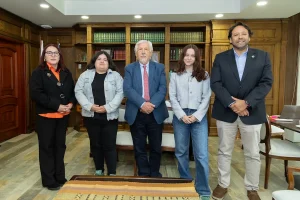
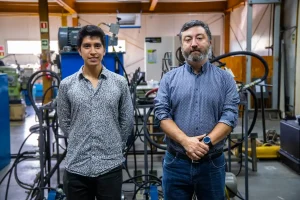
During their visit to UFRO, the researchers toured university laboratories, including the Mechatronics Laboratory of the Faculty of Engineering and Sciences, led by Dr. Eduardo Diez, and also met with the team from the Internationalization Office. For the university, collaborations such as this represent a valuable opportunity to strengthen international links, in this case in the field of geosciences, highlighting work related to natural hazards, volcanology and territorial sustainability.
Jassna Sepúlveda Beltrán
Internationalization Office