
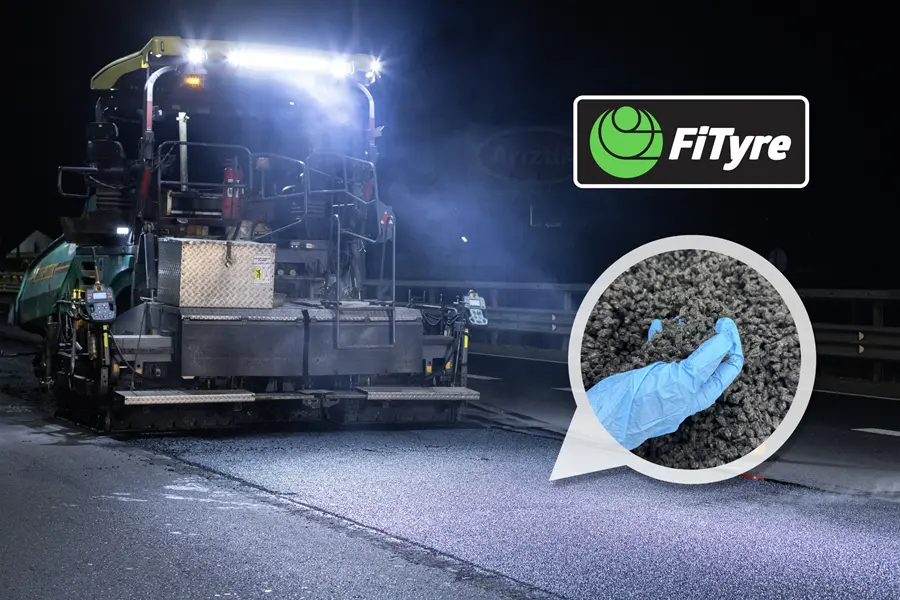
The United States Patent and Trademark Office officially granted the patent for the technology “Granulated additive based on textile fibres from end-of-life tyres, tyre powder and asphalt binder, including the product manufacturing process and its applications”, known as FiTyre®.
This innovation is being driven by the Road Pavement Research Group (GiPAV, its Spanish acronym) of the Department of Civil Works Engineering, within the Faculty of Engineering and Sciences at Universidad de La Frontera (UFRO), through work carried out since 2018 under the leadership of Dr. Gonzalo Valdés Vidal and Dr. Alejandra Calabi Floody, with significant support from the Innovation and Technology Transfer Office (DITT, its Spanish acronym) throughout the entire process.
“This USPTO patent is the definitive recognition of sustained work carried out at UFRO, supported by two Fondef projects that validated the additive from laboratory stage to industrial scale, with successful testing on a section of our national road network (ISA Vías concession: Ruta del Maipo). We already have scientific publications, road innovation awards and advanced discussions for international licensing, now made even more attractive with protection in Europe and the United States”, said Dr. Valdés. He added that the next step, through DITT, is to license this technology to companies capable of manufacturing and commercialising it.
Significance of the Patent
FiTyre® is a technology that enables the creation of an innovative product with applications in the paving industry and road infrastructure construction.
The patented methodology includes both the product manufacturing process and its uses and applications across different contexts.
Taken as a whole, this patent represents international recognition of the technical viability of an innovative solution addressing one of the main environmental challenges in the road industry: the reuse of tyres at the end of their useful life, constituting an important step towards circular economy and environmental sustainability.
Likewise, securing this legal protection tool for intellectual property rights in the United States opens a valuable opportunity for the development and commercialisation of this technology in that market.
Regarding this achievement, the Dean of the Faculty of Engineering and Sciences, Dr. Jorge Farías Avendaño, said that “we are proud that a technology developed within our faculty has reached this level of international validation and is projected as a concrete contribution to sustainability and innovation in road infrastructure. I congratulate the researchers, professionals and collaborators who made this achievement possible, and reaffirm our faculty’s commitment to continue promoting initiatives that connect science, engineering and territorial needs”.
The patent remains valid for 20 years from the filing date of the first application, plus the term adjustments granted by the Patent Office, with an expiry date of 21 December 2042.
Daphne Bormann Parada
Faculty of Engineering and Sciences