
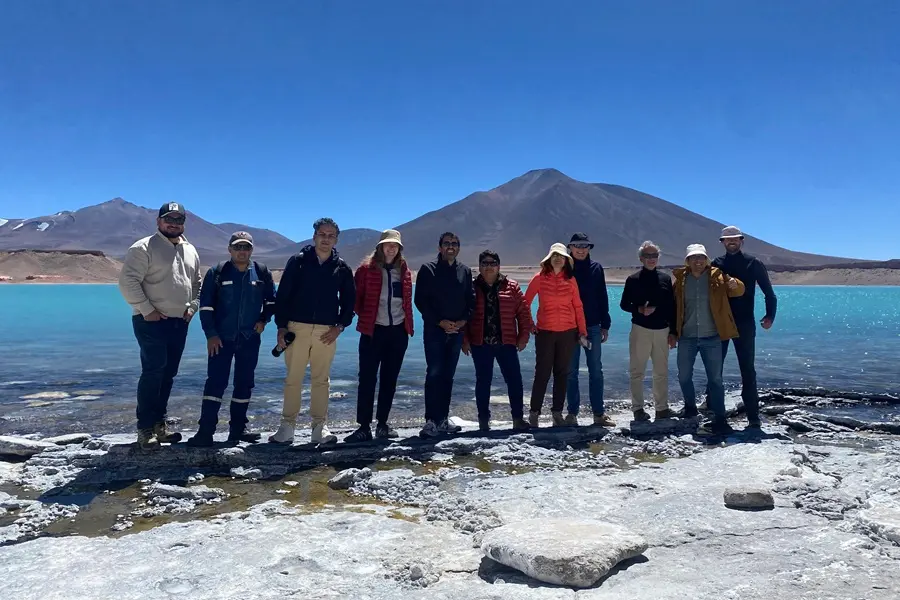
As part of the international project “Filter-LI: direct lithium extraction through membrane technologies”, led by Technical University of Berlin in collaboration with Technical University of Oruro, the University of La Frontera and the company Ad-Infinitum, a team of researchers recently carried out a technical visit to Copiapó to define the installation site for a pilot plant for direct lithium extraction. The plant, based on membrane technologies developed in Germany, is expected to arrive in the country soon and will operate using real brine.
The research, funded by the German Federal Ministry for the Environment, aims to reduce the water footprint of lithium extraction -a mineral essential to the energy transition- through direct lithium extraction (DLE) methods capable of using residual streams to recover other commercially valuable metals.
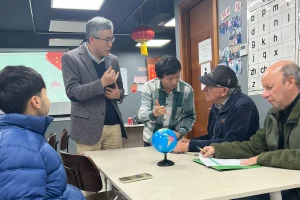
The technical visit, organised with the Instituto de Litio y Salares (InLiSa), led by Hernán Cáceres, also included the participation of the companies Cleantech and Minera Salar Blanco.
Representing UFRO were Christian Antileo Hernández, lecturer in the Department of Chemical Engineering, and Tomás Corvalán Ojeda, a final-year Chemical Engineering student and first-year candidate on the Master’s in Engineering Sciences with a specialisation in Bioprocesses, who presented progress made in preliminary brine conditioning experiments.
“This visit follows a design stage and preliminary experiments carried out in collaboration with the Technical University of Berlin, including assessments of real brines and participation in technical discussions to design the equipment currently being built in Germany and expected to arrive this year”, said Christian Antileo Hernández, adding that this type of applied research initiative helps position UFRO in a strategic field for Chile, from the south of the country, building on long-standing partnerships with national and international universities.
Tomás Corvalán Ojeda also expressed enthusiasm about his participation in the project. “I am passionate about chemical engineering because we specialise in process design, from raw materials to final products, and lithium represents a major technological challenge from southern Chile. Here, in UFRO’s Department of Chemical Engineering, we have researchers with extensive experience in water treatment.”
“I am passionate about chemical engineering because we specialise in process design, from raw materials to final products, and lithium represents a major technological challenge from southern Chile. Here, in UFRO’s Department of Chemical Engineering, we have researchers with extensive experience in water treatment.”
In addition to Tomás, two other students from UFRO’s Chemical Engineering programme — Tamara Riquelme Yévenes and Fernando Saavedra Muñoz — are participating in this international project. Beyond strengthening academic cooperation among national and international institutions, the initiative positions the University of La Frontera as an active contributor to clean technology development for Chile’s lithium industry, linking southern environmental expertise with national needs.
Daphne Bormann Parada
Faculty of Engineering and Sciences