
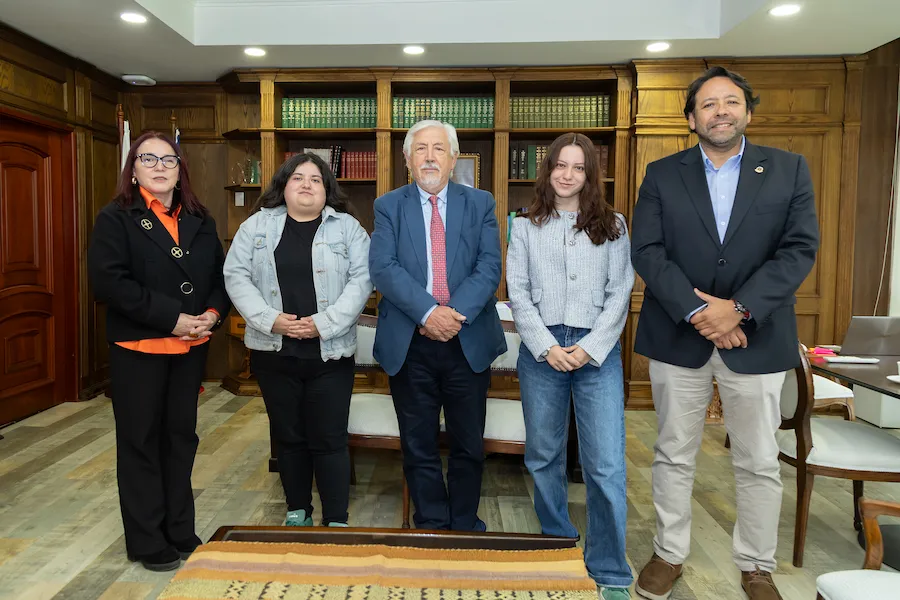
Students from the Faculty of Engineering and Sciences, Samanta Filún Medina and Camila Hormazábal Hernández, creators of Café a la Carta (“Coffee Made to Order”), were recognised in this national competition, a result that will allow them to travel to the United States to present their innovation, which was previously awarded US$15,000 in 2025 for its development. In this latest edition of the competition promoted by Copec, one of Chile’s leading companies in fuels, lubricants and energy distribution, the project was once again recognised, enabling the students to travel in April to San Francisco to take part in a one-week internship aimed at strengthening the initiative, building networks with start-ups and entrepreneurs, and connecting with strategic actors within the innovation ecosystem of Silicon Valley.
“The project consists of taking coffee grounds, which are currently a waste product not utilised in Copec service stations, and creating two valorisation pathways through which we obtain a hybrid biomaterial made of bacterial and plant cellulose. In this way, we close the cycle by producing the same cups in which coffee is sold at Copec, integrating the waste into the same production chain”, explained Samanta Filún, a Biotechnology Engineering student and member of the Café a la Carta team.
Meanwhile, Chemical Engineering student and project participant Camila Hormazábal Hernández added that “what we aim to do is reduce coffee waste, specifically the grounds left after each cup served by each machine, reducing it by half or more in order to produce the coffee cups that people will later drink from. It is essentially about understanding that the waste from your coffee today will become the cup for your coffee tomorrow, allowing each person to contribute to circularity and environmental sustainability”.
The Dean of the UFRO Faculty of Engineering and Sciences, Jorge Farías, said that “what the students have achieved in a highly competitive contest, which initially brought together around 400 initiatives, is a source of great pride. This achievement places the training provided by our Faculty and the University at the highest level”, and stressed that “for five years we have been working on curricular innovation within our Faculty under the umbrella of the Ingeniería2030 project, which specifically seeks to train world-class engineers”.
The jury, chaired by Arturo Natho, highlighted Café a la Carta for the innovative nature of its solution, the impact of its pilot project, the strength of its proposal, and its potential to become a scalable solution within the company’s service ecosystem.
An idea developed at UFRO
Café a la Carta emerged in response to the large volume of coffee grounds generated at service stations, a waste product that can reach nearly one thousand tonnes annually. From this material, the students developed a circular economy solution aimed at producing sustainable packaging.
The proposal involves the creation of a hybrid biomaterial through two processing pathways: on the one hand, the production of bacterial cellulose through microorganism cultures capable of generating a high-purity nanofibrillar structure; and on the other, the extraction of plant cellulose, which significantly reduces waste volume and recovers fibres to reinforce the final material, resulting in a compostable, durable and thermally stable product with potential application in coffee cup manufacturing as a more sustainable alternative for the industry.
The project was developed with support from Karina Godoy Sánchez, from the Núcleo Científico Tecnológico en Biorecursos (BIOREN-UFRO), and Juan Pablo Guineo Alvarado, from the Department of Chemical Engineering, strengthening its scientific basis and practical application.
According to Samanta Filún Medina, a member of Café a la Carta, “this project began with the most basic concepts provided by the university, which then need to be applied in order to develop ideas of this kind. BIOREN researchers supported us greatly, from the materials we needed to use to the knowledge required to continue developing the project”.
Meanwhile, Camila Hormazábal Hernández, also a member of the project, said that “with the trip now scheduled, we are looking to broaden our perspective and find support to continue scaling up the project”.
The Café a la Carta initiative reflects UFRO’s distinctive approach by linking academic training, applied research and innovation with a focus on sustainability, enabling students to develop concrete solutions to real challenges within their local context, with national and international reach and the capacity to engage with highly competitive ecosystems.
Benjamín Bustos Jiménez
Faculty of Engineering and Sciences