
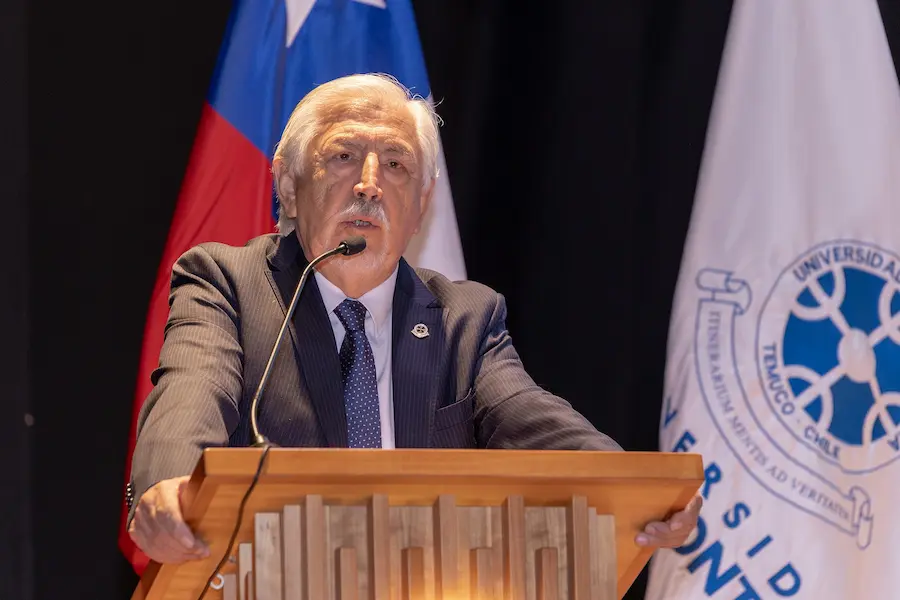
Cross-cutting approaches and gradualism will serve as guiding principles for the Universidad de La Frontera, shaping adjustments and strengthening performance across key areas such as undergraduate and postgraduate education, research, engagement with the external environment and university management.
The Rector, Dr. Juan Manuel Fierro, made these remarks during the Ceremony for the Inauguration of the 2026 Academic Year and the 45th Institutional Anniversary.
Local, regional and university authorities gathered in the University’s Aula Magna to take part in the event, which was attended by the National Prize for Exact Sciences (Chile) 2025, Dr. Alejandro Maass Sepúlveda, Full Professor in the Department of Mathematical Engineering at the Faculty of Physical and Mathematical Sciences of the University of Chile, who delivered a lecture reflecting on the contribution of science, innovation and universities in addressing the major challenges of contemporary society.
“The scale of the tasks, the stakeholders involved, the areas concerned and the outcomes we aim to achieve require a progressive and scalable effort across all dimensions currently considered in the assessment of university quality and excellence. I am confident that, in pursuing these goals, the university community will once again commit its full range of talents to the service of the institution”, the Rector emphasised.
Specific Priorities
With regard to the priorities defined by the institution for 2026, Rector Dr Juan Manuel Fierro stated that the revision of the academic career framework constitutes a cross-institutional priority. Its central purpose will be to recognise and value talent, as well as the disciplinary and professional diversity of human capital. “This initiative seeks to incorporate professionals whose strengths extend beyond a purely research dimension, adding capacities, competencies and profiles that enable the institution to respond to a broader range of demands”, he noted.
A second institutional priority will be the evaluation and redefinition of university regulations. The year 2026 will require a reassessment and review of provisions governing critical areas of management, with the aim of developing flexible structures that provide opportunities for growth and development. “We require a regulatory framework that is more functional to our purposes and needs, aligned with those governing the public sector, yet oriented towards addressing, in a timely and effective manner, the challenges we currently face as an institution”, the Rector emphasised.
Another key priority will be the diversification of income streams. During 2026, progress will be made in generating initiatives aimed at diversifying funding sources, supporting and fostering science- and technology-based enterprises, the delivery of continuing education programmes, as well as the commercialisation of patents and licences. Likewise, efforts to secure external funding will be intensified, progressing decisively towards the establishment of partnerships with the private sector.
Advancing changes, adjustments or the creation of new tools across each of these areas requires a fourth major intervention: sustained progress in the design of a framework for digital and technological governance. In this regard, the Rector indicated that “progress will be made on projects for the automation of key processes, integrating artificial intelligence, alongside investment in new technologies applied to education, management, digital transformation and data governance”.
Recognition
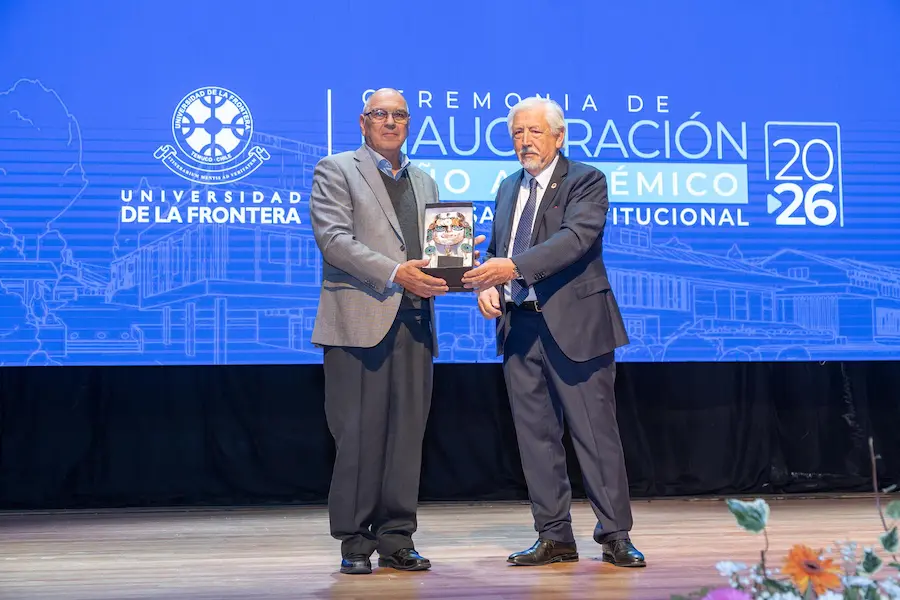
At the Ceremony for the Inauguration of the 2026 Academic Year, the Universidad de La Frontera paid special recognition to the service and contribution of Dr. Plinio Durán García, who served as Secretary General of the institution for fifteen years.
His work proved fundamental in strengthening regulatory processes, institutional life and the safeguarding of the principles that guide the University’s mission. Authorities highlighted his commitment, rigour and dedication to service, which contributed significantly to the development and consolidation of the University.
“One always values recognition. It shows that one’s work has been visible. I am grateful for this recognition, as it signals that the work one has carried out is appreciated. This is not the achievement of a single individual; it reflects the efforts of a highly committed team. More than a recognition for me, it is a recognition for the entire team that makes up the General Secretariat”, Dr. Plinio Durán stated at the conclusion of the ceremony.
Lecture by Chile’s National Prize Laureate
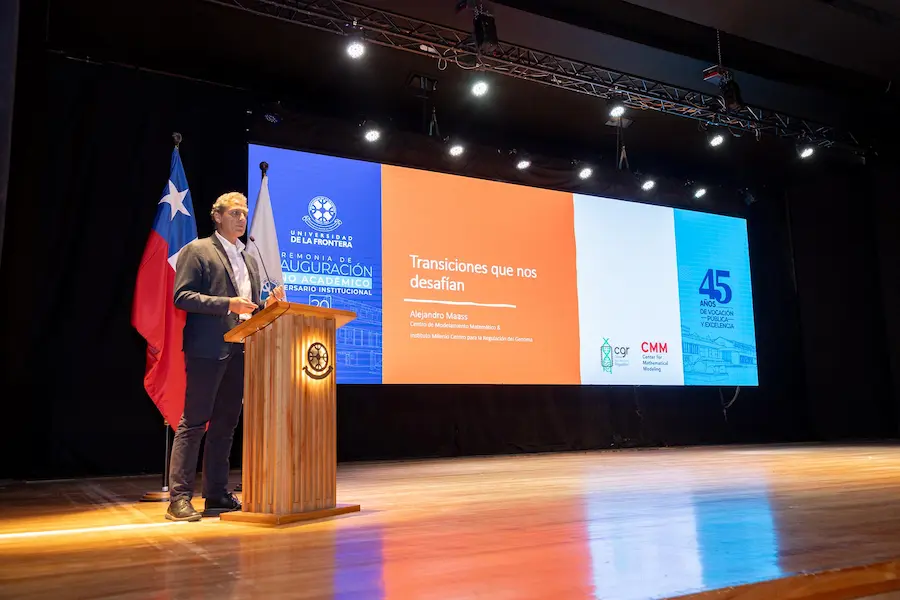
A reflection on the contribution of science, innovation and universities in addressing the major challenges of contemporary society was the focus of the lecture delivered to attendees at the Ceremony for the Inauguration of the 2026 Academic Year by the National Prize for Exact Sciences (Chile) 2025, Dr. Alejandro Maass Sepúlveda, Full Professor in the Department of Mathematical Engineering at the Faculty of Physical and Mathematical Sciences of the University of Chile.
“For all institutions, and particularly for regional universities, opportunities for development lie in harnessing the transitions we are currently experiencing in areas such as climate, food systems, technology and society, in order to build institutions that respond to these challenges in a timely and dynamic manner. Regional universities hold a significant advantage over many more centralised institutions: they operate close to where these paradigms are unfolding. There is, I believe, a major opportunity to establish themselves as key hubs for local and regional development”, Dr. Maass emphasised.
To see more images of the event, click here
Sergio Valenzuela Sanzana
Communications Office