
Universidad de La Frontera (UFRO) took an important step in the field of interculturality by holding the first session of the Mapuche Interculturality Roundtable, an initiative that marks the beginning of a key stage in the implementation of the Intercultural Relations Policy approved by the institution in 2025.
The initiative is led by the coordinator of the Intercultural Relations Policy at the Academic Vice-Rector’s Office and academic staff member of the Faculty of Engineering and Sciences, Mg Leonardo Lleuful Cruz, who highlighted the importance of creating participatory spaces that enable progress towards consolidating a university with an intercultural identity.
‘The participation of the different sectors of our university community is essential to building a policy that is respectful, representative and relevant to our territory. As a state university, we have the responsibility to strengthen an intercultural identity that is visible both within the institution and in our relationship with society’, he said.
Participation Across the University Community
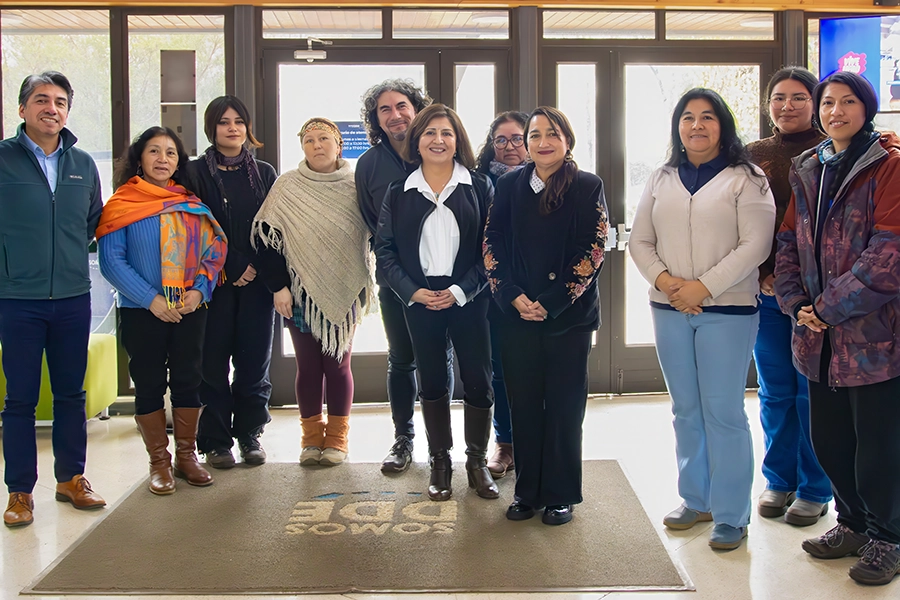
The meeting brought together representatives from the academic, professional and student communities, along with various university units and organisations involved in promoting Mapuche culture. Its objective is to coordinate actions that incorporate an intercultural approach across teaching, research, engagement with society and institutional management.
One of the participants, Sociology student and representative of the Ankatü Collective of Mapuche Students at the Andrés Bello Campus, Pamela Reyes Clavería, welcomed this institutional progress.
‘We first envisioned this more than a year ago, and today we are seeing it begin to take shape. We are very pleased and grateful that students’ voices are being heard and that our place within the University is being recognised. We hope this process will be successful and will help strengthen the institution’s relationship with the Mapuche Nation’, she said.
Likewise, Marisol Domihual Infante, staff member at the Directorate of Libraries and Information Resources (DIBRI) in the Central Library and representative of General Services staff on this occasion, highlighted the importance of strengthening spaces for gathering and cultural recognition within the Andrés Bello Campus.
‘The opportunity to have spaces such as the ruka and the paliwe is highly significant for those who come to the University, whether students or staff, because it allows them to identify with our culture. I am very pleased with what is being achieved and hope that we can continue to make progress and bring many more initiatives to fruition in the future’, she stated.
For his part, the Director of Student Development, Dr Pablo Martínez Riquelme, highlighted the beginning of a process aimed at consolidating the University as a benchmark in interculturality through the cross-cutting incorporation of the Mapuche worldview into university life.
‘We are very pleased because we are beginning work that will have an impact in both the short and long term. We are moving along a path that will be historic for the University and that will strengthen interculturality in teaching, research, the protection of spaces and our relationship with the territory’, he noted.
Meanwhile, the Director of the Institute of Indigenous and Intercultural Studies, Mg Osvaldo Curaqueo Pichihueche, stressed the importance of bringing together the capacities and experience that already exist within the University in order to strengthen the implementation of the policy.
‘The first step is coordination. The University has established capacities across different units and faculties, in addition to the experience accumulated by the Institute of Indigenous and Intercultural Studies over more than 30 years. This work enables us to project ongoing actions that give visibility to Indigenous peoples, and particularly to the Mapuche people, throughout the year’, said the Roundtable member.
The work of the Roundtable is based on various regulatory frameworks, including the Higher Education Law for State Universities, the new UFRO Statutes and Convention No. 169 of the International Labour Organization (ILO). It will also guide its work according to principles of the Mapuche worldview, such as linguistic justice, Fill Mogen – the diversity of life – and Küme Mogen – good living – advancing a roadmap aimed at consolidating an institutional vision in which cultural diversity is a fundamental pillar of university and territorial development.
Abelardo Silva García
Communications Office